Driver Inc rules Canada: what the CRA crackdown changes
Driver Inc rules in Canada, the CRA test behind them, and what a carrier has to document to stay clear of a personal services business finding.

The pitch is easy to repeat. Incorporate, and the carrier pays your corporation instead of paying you. No source deductions come off the cheque. No CPP or EI split. The number that lands in your account looks bigger.
The Driver Inc rules in Canada exist because the CRA has spent years arguing that most of those arrangements are payroll in disguise. The structure is what is under scrutiny. Not the driver.
What the structure actually is
The shape is simple. A carrier. A driver. A corporation the driver owns.
The carrier signs a service contract with that corporation. The driver shows up in the carrier's truck, runs the carrier's loads, under the carrier's dispatch, at a rate the carrier sets. The corporation invoices the carrier each month. The driver pays themselves out of whatever is left.
On paper, that is one business selling services to another. In practice, the driver answered to a single dispatcher for the whole year.
That gap is the entire issue. A corporation is a real thing, and a driver with a genuine book of business is allowed to run one. The trouble starts when the corporation has one client and the person inside it works like an employee.
Driver Inc rules in Canada: the test that decides it
The CRA does not start with the contract. It starts with the working relationship and asks whether the contract describes it.
Two conditions carry most of the weight. A shareholder of the corporation performs the services. And but for the corporation, that person would reasonably be considered an employee of the client.
If both hold, the corporation is a personal services business. That is the label that turns a structure sold as a small business into a tax problem.
The older common law test does the rest of the work. Control. Who owns the tools. Who has a chance of profit. Who carries the risk of loss.
One client is a warning sign. The carrier's truck is a warning sign. Fixed hours on the carrier's schedule is a warning sign. A contract that calls the driver a contractor proves nothing when the facts say employee.
The arithmetic of compliance, and the arithmetic of penalty
Start with the legitimate version.
A real corporation has more than one customer, its own risk and its own costs. It takes revenue, subtracts real business expenses and pays tax on what remains. It claims the small business deduction. The owner chooses between salary and dividend.
Now run the personal services business finding instead.
The deductions go away. Salary and benefits paid to the incorporated employee cannot be deducted against the corporation's income. Ordinary business expenses the corporation would normally claim are denied. The corporation is taxed at the general corporate rate rather than the small business rate.
Stack those and the corporation pays tax on something much closer to gross revenue than to profit. The margin the structure was built to protect is the amount being taxed.
Then the personal side arrives. CPP and EI come back through the deemed employment. The payer faces payroll liability, penalties and interest on source deductions that should have been remitted from the first pay period.
We are not printing a dollar penalty here, and you should be suspicious of any page that does. The exposure runs through your province, your payroll and your tax year. The CRA publishes the rate tables and the penalty schedule. Those are the figures that apply to you.
Here is the part carriers underrate. The assessment does not land on the driver alone. A carrier that ran a Driver Inc fleet carries the payroll exposure for every driver it should have placed on payroll, and a reassessment can reach back through prior years at once.
What the crackdown changes for a carrier
Paper has to match the facts, and the CRA compares the two.
A written service contract. Invoices, with HST where the corporation is registered. Proof of WSIB coverage or a private policy. Evidence the driver can take other work and does. Records showing who dispatched the loads and who set the rate.
If the driver can work for someone else but never does, that is a fact. If the driver owns nothing but the corporation, that is a fact. If the carrier's dispatcher controls the day, that is a fact. No contract template overrides any of them.
So the practical move is not a sharper contract. It is deciding, driver by driver, whether the relationship is employment or a business, then documenting the version that is true. A carrier running both has to be able to tell them apart on paper and in practice.
The numbers that move a driver's margin more
The structure is sold on a tax saving. The fuel line in front of it is larger.
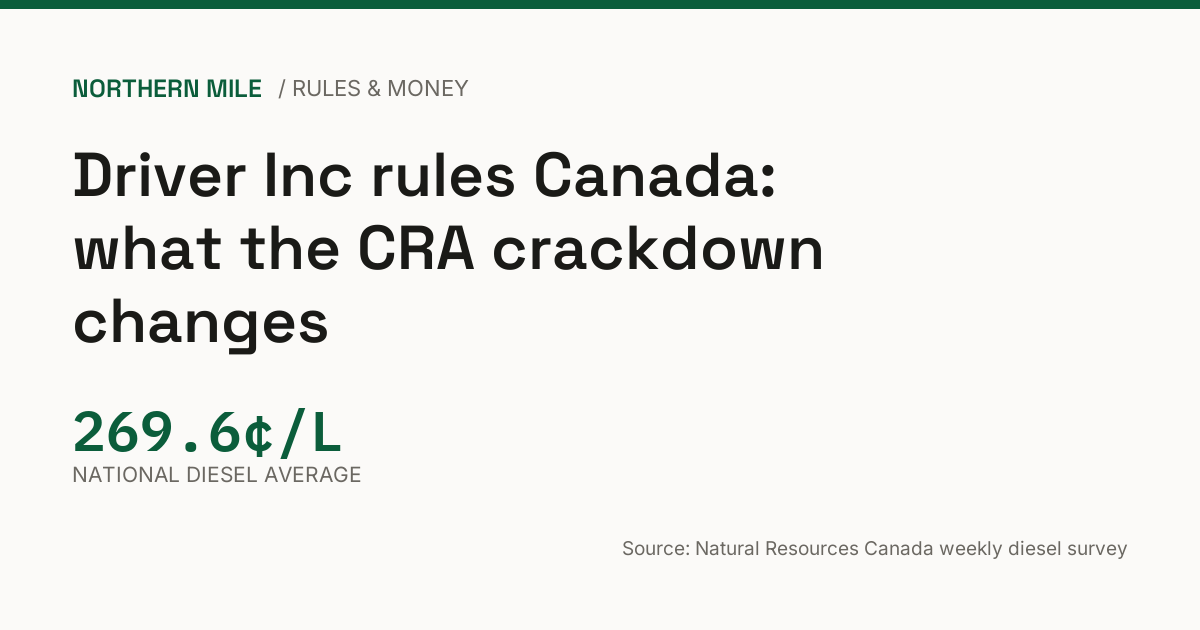
Natural Resources Canada put the national diesel average at 269.6 cents a litre on the 22 September print. Quebec carried the highest litre in the country at 295.2. The Northwest Territories carried the lowest at 213.9. The spread between them is 81.3 cents a litre, for one product, in one week.
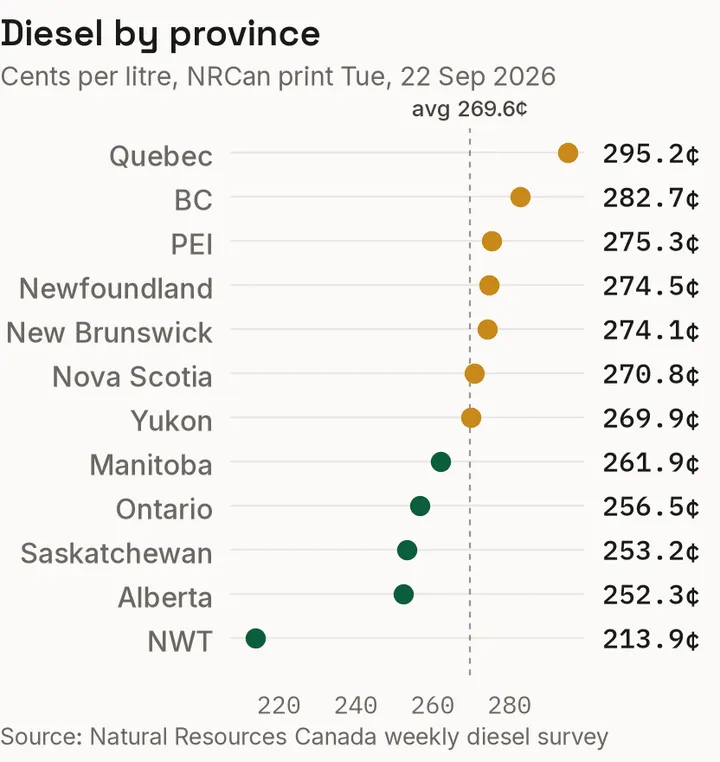
Provincial diesel prices against the national index, per the NRCan weekly survey.
Read that as a driver, not an economist. A swing of 81.3 cents a litre moves a real margin, and it is a lever you actually control. If your lane puts you on a Quebec fill, Montreal is where most of that province's truck traffic buys, and it prices off the top of the board. A fill on the Alberta side, Calgary included, comes off a much lower number.
The currency sits underneath all of it. The Bank of Canada rate was 1.4136 on 24 September, with the loonie weakening 0.28 per cent. Crude is priced in US dollars, so a weaker loonie lifts the Canadian cost of the same barrel in every province at once. If your revenue arrives in US dollars and your costs are Canadian, the exchange rate is doing more to your year than the corporate structure is.
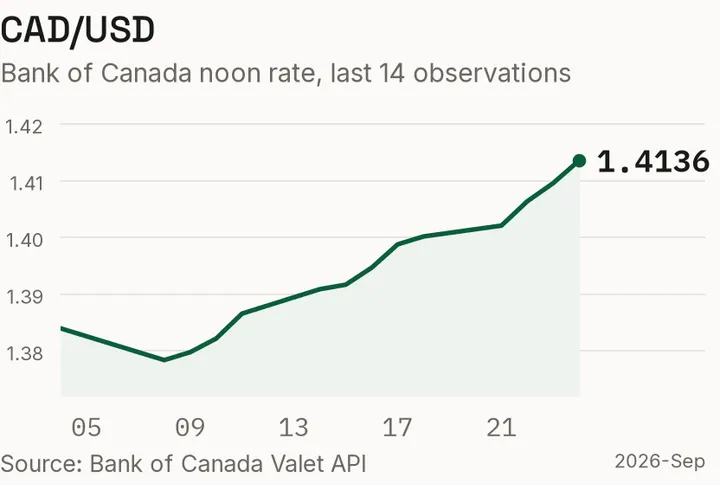
The Canadian dollar against the US dollar, recent observations.
The EIA put US diesel at $6.529 a gallon. That figure is in US dollars and US gallons, so it does not slide into the Canadian table without a conversion. It matters at the negotiating table, where a cross-border rate has to cover a fuel cost priced in somebody else's money.
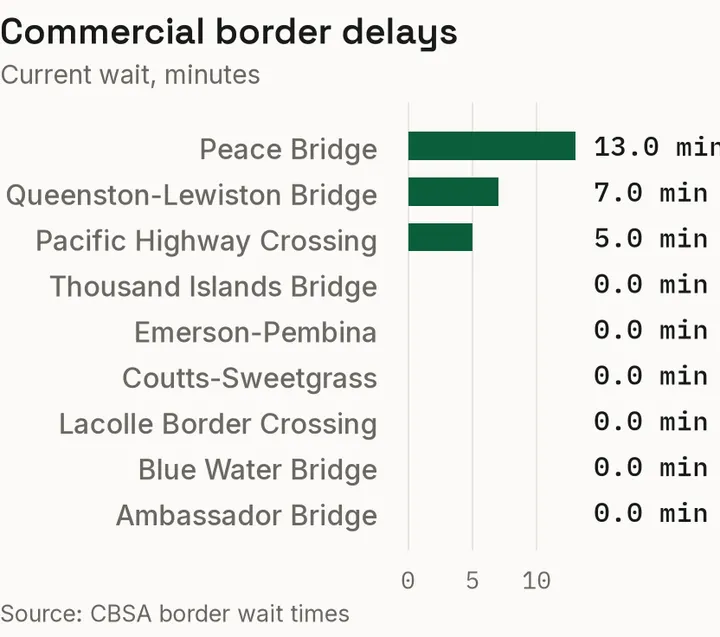
Current commercial wait times at CBSA-reported crossings.
Then the clock. CBSA commercial wait times sat at 13 minutes at Peace Bridge, 7 minutes at Queenston-Lewiston and 5 minutes at Pacific Highway. Ambassador Bridge, Blue Water Bridge, Lacolle, Coutts-Sweetgrass and Emerson-Pembina were all clear.
Here is where the border meets the structure question. A contractor on a mile rate absorbs the wait. An employee on the clock does not. If Peace Bridge is your crossing and it is carrying the longest reported wait on the board, that time comes off your own day. It is also the kind of fact that makes a single client relationship look like employment.
The short version
The Driver Inc rules in Canada come down to one question. Does this driver run a business, or does this driver work for one carrier with a corporation sitting over top. The CRA answers that from the facts of the relationship, not the wording of the contract.
If the answer is employment, the arithmetic flips. Deductions disappear, the rate rises, and payroll exposure lands on both sides of the deal. If the answer is a real business, keep the records that prove it and the clients that prove it.
Either way, watch the numbers you can actually move. City level diesel prices, live commercial wait times at every tracked crossing and a per lane fuel cost calculator are on the dashboard, free, with no login. Run the fuel cost calculator on the lane you drive before you accept a rate.
Sources: Natural Resources Canada weekly diesel survey (retail diesel, Tuesday print). Bank of Canada Valet API exchange rate series. CBSA border wait times. US Energy Information Administration weekly diesel price. Canadian Revenue Agency guidance on personal services business and Driver Inc arrangements. Methodology, including how the national average is calculated: https://dashboard.northernmilemedia.com/methodology/nmdi/