Canada's national diesel average this week
The national diesel average is 267.1 cents a litre. The 53.2 cent gap between Quebec and Alberta is the number that moves your margin.


Canada's diesel average is 267.1. The 53.2 cent spread matters more.
Canada's national diesel average is 267.1 cents a litre. That comes from the NRCan weekly survey printed Tuesday, 15 September.
It is also the least useful number in this post.
The figure that moves your margin is the gap between the cheapest and the most expensive province. Right now that gap is 53.2 cents. Quebec pays 296.3 at the pump. Alberta pays 243.1. Same fuel, same country, same week.
If you run long haul, you already know this in your bones. You also know the spread is not evenly distributed. It clusters.
Where the fuel sits this week
Quebec sits at the top at 296.3. Newfoundland and Labrador is next at 282.3. Then British Columbia at 277.7 and New Brunswick at 276.3. Prince Edward Island lands at 273.0 and Nova Scotia at 270.0.
Ontario is the last province above the national average, at 261.0.
Below that line the prices fall off faster. Yukon is 249.9. Manitoba 247.3. Saskatchewan 244.1. Alberta 243.1. Northwest Territories brings up the bottom at 213.8.
Notice the shape of it. Six provinces above the national number, six below. The western provinces and the territories cluster tightly. The eastern provinces do not.
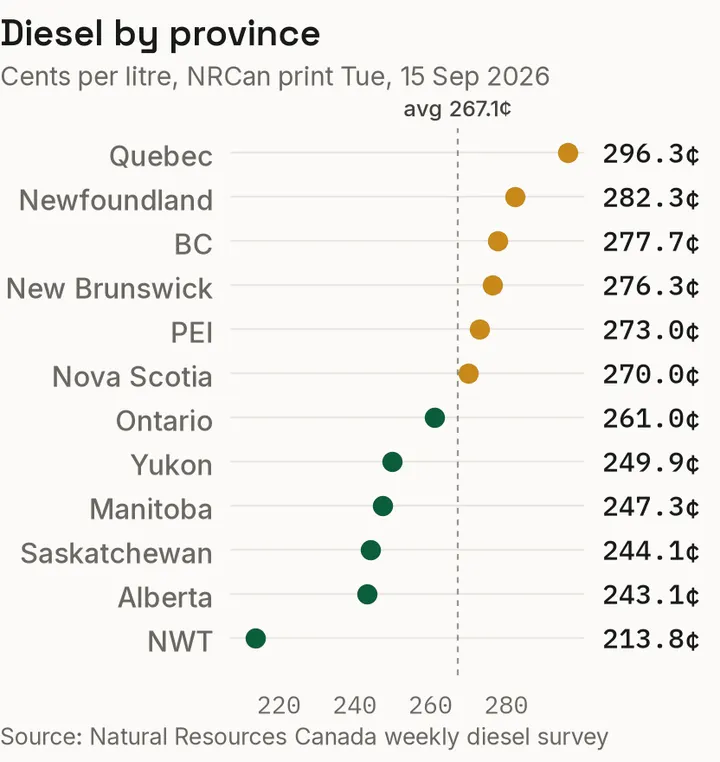
Provincial diesel prices against the national index, per the NRCan weekly survey.
That is 72 locations surveyed across 12 provinces. The national average is a real measurement, not an estimate. It is just an average of a country where the cost of fuel is genuinely different depending on where you park.
For an owner-operator, the practical read is simple. If your lanes keep you east, your fuel cost base is higher than the national figure suggests. If your lanes keep you west, it is lower. Plan your fills accordingly.
The dollar is not helping
The Canadian dollar closed at 1.4002 against the US dollar on 18 September, a move of 0.10 per cent.
A weaker loonie matters to you more than it matters to most people. Crude is priced in US dollars, so a soft Canadian dollar raises what refiners pay to bring it in. Some of that shows up at the pump later, and some of it gets absorbed. Which way it lands depends on margins you and I never see.
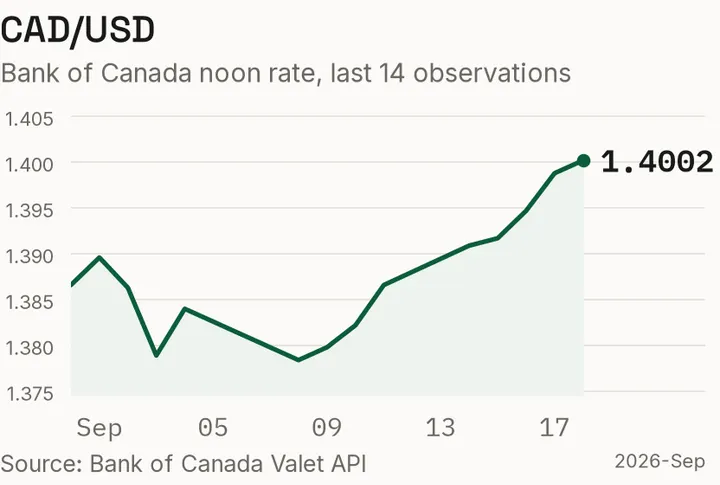
The Canadian dollar against the US dollar, recent observations.
There is a second angle here, and it works in your favour if you haul cross-border. US diesel came in at 6.285 dollars a gallon on 14 September. When you are negotiating a rate that covers fuel on both sides of the line, that number is ammunition. Know it before you sit down.
The border is mostly moving
Nine crossings are tracked on the dashboard. Six of them were clear at last check.
The exceptions are all on the eastern side. Pacific Highway Crossing was showing 20 minutes. Peace Bridge was at 10 minutes and carrying a notice. Queenston-Lewiston Bridge was moving at 3 minutes.
Clear at last check were Ambassador Bridge, Blue Water Bridge, Lacolle, Coutts-Sweetgrass, and Emerson-Pembina.
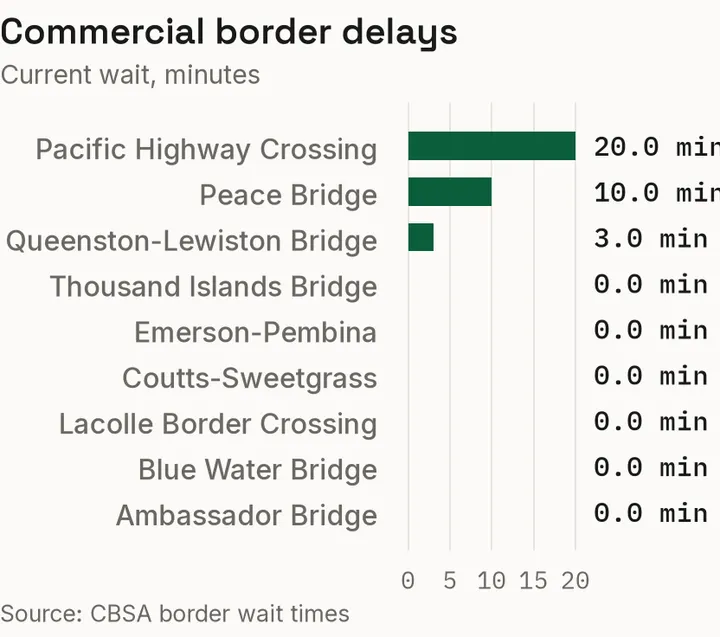
Current commercial wait times at CBSA-reported crossings.
Twenty minutes does not sound like much until you are the one sitting in it. Multiply it across a week of crossings and it becomes a scheduling problem rather than a delay.
One thing about the timing
The NRCan survey prints once a week. This week's print landed Tuesday, 15 September.
If you are reading this a few days later, the pump has already moved. That is not a flaw in the data. It is just how a weekly survey works. The dashboard carries the current print and refreshes when the next one lands, so it is always showing you the latest week rather than this post's version of it.
What to do with this
Three things worth acting on.
Check the provincial spread before you plan fills on a long run. The difference between a fill in Alberta and a fill in Quebec is 53.2 cents a litre, and that is a real number on a real invoice.
Watch the exchange rate if you cross-border. At 1.4002 the loonie is soft, and that changes what fuel costs you on the US side.
Give yourself room on eastern crossings. Pacific Highway and Peace Bridge were the two carrying delays this week.
The dashboard updates every week with the same numbers behind this post. If you want the underlying tables rather than the summary, they are all here.
Sources
Diesel prices: Natural Resources Canada weekly diesel survey, printed Tuesday, 15 September 2026.
Exchange rate: Bank of Canada Valet API, 18 September 2026.
US diesel: US Energy Information Administration, 14 September 2026.
Border wait times: Canada Border Services Agency, live at time of writing.
Full methodology at https://dashboard.northernmilemedia.com/methodology/.