What cargo theft takes first, and where loads go missing
Cargo theft trucking Canada and US: the loads thieves take first, in order, and the parked hours where most of them go missing.

A loaded trailer parked for the night is the easiest thing on the road to take. It cannot fight back. It cannot drive away. The driver is asleep, eating, or in the washroom. That is the whole game in cargo theft trucking across Canada and the US.
Our theft tracking carries one ranking of what gets taken, and it does not open with cash or jewelry. This week the feeds behind that tracking matched no new Canadian theft headlines. A quiet week is not a safe week. The order below is what the tracker holds, not a count of this week's losses.
What gets taken first
Electronics and appliances sit at the top. Phones, tablets, televisions, small appliances. High value for the weight, sold the same day on a marketplace listing, and nothing on the box ties the pallet back to you once it is gone.
Food and beverages ride second, and reefers take the worst of it. A stolen grocery load does not need a buyer with a warehouse behind it. It needs a market and a few hours. Food is eaten and gone before a recovery unit gets called.
Building materials and metals come third. Copper wire, tools, fasteners, roofing. Bulky, easy to sell to a contractor, and close to impossible to trace once it is off the pallet.
Clothing and footwear land fourth. Boxes of apparel run through discount channels fast, and a full trailer is worth the effort to a crew that has done this before.
Auto parts and tires close the list. Universal demand, no serial number on a tire, and a buyer on almost every corner.
The order makes sense once you say it out loud. A thief is looking for the load that turns into cash fastest, with the fewest questions asked. Everything on that list moves in hours, not weeks.
Where the loads go missing
Almost none of this happens at highway speed. It happens when the wheels stop.
Truck stops and rest areas lead, because that is where a driver sleeps. Drop yards and customer lots follow, because that is where a trailer sits until the receiving dock opens. The third spot is the one drivers forget. It is the back of a border queue. A truck waiting on a crossing is a truck standing still with a loaded trailer, and that is the same window a yard hands a thief.
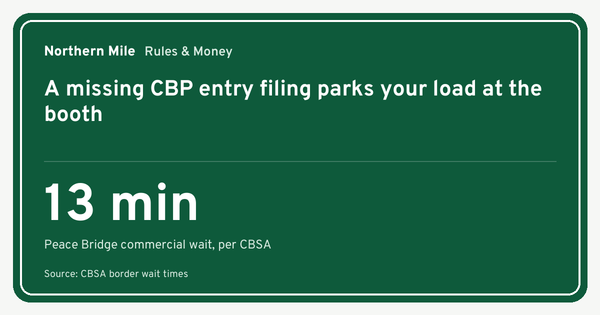
The border board is mostly clean today, and the delays that exist are short. Peace Bridge is running 13 minutes. Queenston-Lewiston is at 7. Pacific Highway Crossing is at 5. Ambassador Bridge, Blue Water Bridge, Lacolle, Coutts-Sweetgrass and Emerson-Pembina are all clear.
| Crossing | Commercial wait |
|---|---|
| Peace Bridge | 13 min |
| Queenston-Lewiston Bridge | 7 min |
| Pacific Highway Crossing | 5 min |
| Ambassador Bridge | clear |
| Blue Water Bridge | clear |
| Lacolle | clear |
| Coutts-Sweetgrass | clear |
| Emerson-Pembina | clear |
Source: Canada Border Services Agency border wait times, current readings.

Current commercial wait times at CBSA-reported crossings.
Do not read a short wait as a free pass. Thirteen minutes is still thirteen minutes with the doors shut and the driver watching the mirrors. A clear crossing is faster. Faster is better for the load.
What the fuel stop has to do with a stolen load
Where you buy diesel and where you park for the night are often the same decision.
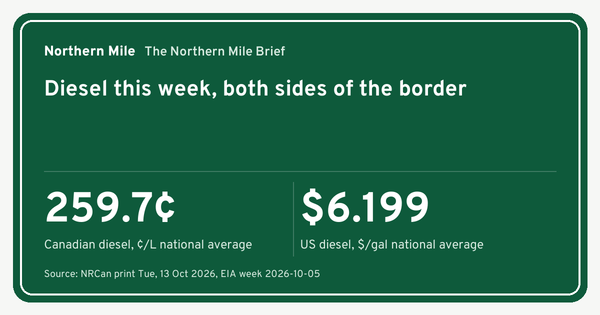
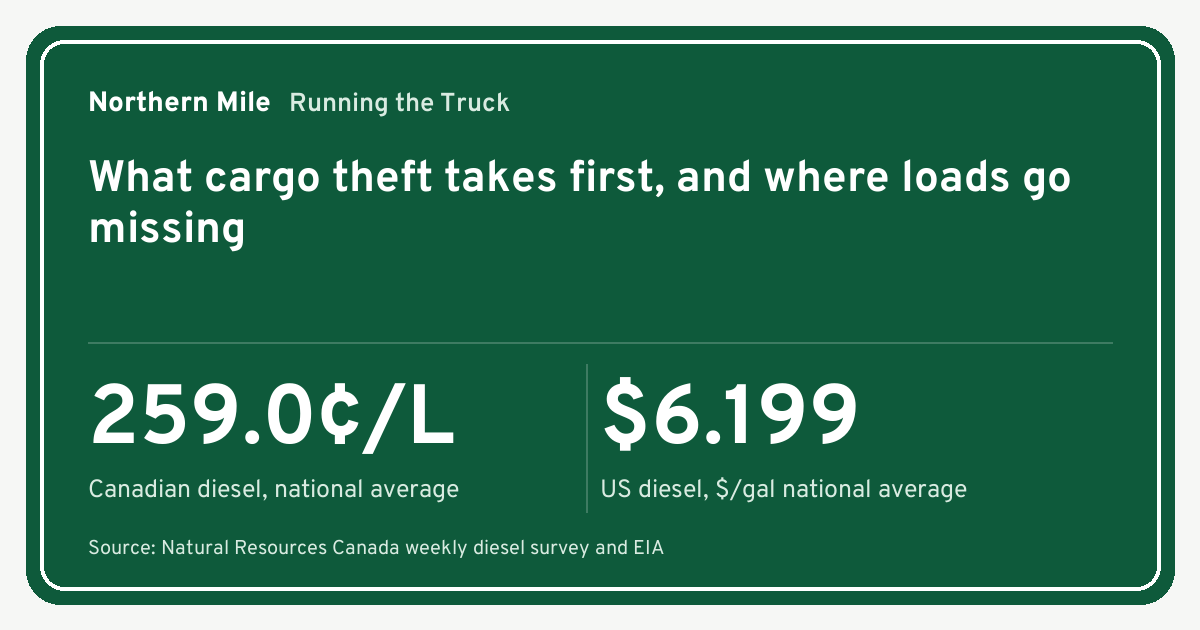
NRCan printed the national average at 259.0 cents a litre this week. Quebec is the dearest market at 290.4. The Northwest Territories is the cheapest at 222.6. The spread between them is 67.8 cents a litre, and it is the widest lever a fuel plan has.

Diesel prices by province and territory, against the ten-province national index, per the NRCan weekly survey.
That spread pulls drivers toward the cheap end of the map. Cheap fuel towns are not always the towns with a fenced yard and a camera on the gate. A driver chasing 67.8 cents a litre can end up overnighting in a lot that saves a few dollars at the pump and hands a thief an easy trailer. The stop that saves fuel is the stop you also have to sleep at, so pick it for both.
Cargo theft trucking Canada US is one problem
A load taken outside Toronto and a load taken outside Chicago do not stay in their own countries. Both disappear into the same resale channels. Both get reported to the same insurers. A border does not slow a stolen pallet down.
Cross-border loads are also worth the most per unit, which puts them at the front of the line for a thief. The Bank of Canada has CAD/USD at 1.424 this week, with the loonie strengthening 0.1 percent. US diesel printed at 6.199 dollars a gallon on October 5. Those two figures decide how a cross-border lane prices, and a lane that prices well is a lane that runs the freight thieves want.

The Canadian dollar against the US dollar, recent observations.
None of that changes the fix. Move the loads that attract thieves on routes and at hours where a trailer is never left alone.
What a driver actually does differently
Park where the trailer is inside a fence or under a camera, not where the fuel sign is lowest. Ask the counter about overnight security before the truck gets shut down.
Record the seal number when the doors close, and check it against the paperwork at every stop. A broken seal is the first sign of trouble. A missing one is worse.
Keep the doors shut and locked at every stop, including the short ones. A five minute break with the doors open is enough time for a load to shed a few pallets.
Photograph the trailer, the seal and the plate at each stop. A time-stamped photo is the record that holds up after the fact.
For high-value loads, use a secured yard and pay for it. The cost of a guarded spot is smaller than the claim, the deductible and the lost lane.
Where this leaves the load
Cargo theft is a targeting problem. Thieves take what sells fastest, and they take it when the truck is standing still. The ranking names the load. The schedule names the place. The fix sits with the driver at the wheel.
Watch the border trends page before you plan an overnight near a crossing, and check the Peace Bridge board the day you run it. The Quebec diesel page shows the dearest fuel on the map, and the Calgary page shows the cheap end where the parking math changes. Run your own lane cost on the fuel cost calculator before you decide where the truck sleeps.
Cargo theft trucking Canada US comes down to the same two questions in both countries. What is on the trailer, and who is watching it while the wheels are stopped.
Sources: Natural Resources Canada weekly diesel survey, Bank of Canada Valet API, Canada Border Services Agency border wait times, US Energy Information Administration. Methodology: https://dashboard.northernmilemedia.com/methodology/nmdi/