Why Canadian and US diesel prices don't compare directly
Canadian diesel printed 261.4 cents a litre with a 68.0 cent spread. A Canada US diesel price comparison is harder than it looks. The loonie sits at 1.4246.


Two surveys. Two units. Two clocks. A Canada US diesel price comparison looks like a subtraction until you try to run one.
Natural Resources Canada printed the Canadian national average at 261.4 cents a litre on Tuesday, September 29. Quebec sits highest at 291.9. The Northwest Territories sits lowest at 223.9. The spread between them is 68.0 cents a litre, and that number changes a fuel plan more than any national headline does.
The Canadian half of the comparison
The NRCan weekly survey is the cleanest reading on the board this week. Every province and territory it covers printed a single number.
| Market | Diesel, cents per litre |
|---|---|
| National average | 261.4 |
| Quebec | 291.9 |
| Newfoundland and Labrador | 272.3 |
| New Brunswick | 270.7 |
| Yukon | 269.9 |
| British Columbia | 269.3 |
| Nova Scotia | 265.8 |
| Ontario | 254.1 |
| Prince Edward Island | 253.6 |
| Saskatchewan | 248.9 |
| Manitoba | 248.0 |
| Alberta | 239.5 |
| Northwest Territories | 223.9 |
Source: Natural Resources Canada weekly diesel survey, printed September 29.

Provincial diesel prices against the national index, per the NRCan weekly survey.
The expensive end is coastal. Quebec, Newfoundland and Labrador and New Brunswick lead it, with Yukon and British Columbia close behind. The cheap end runs through the middle of the country. Northwest Territories, Alberta, Manitoba and Saskatchewan hold the low ground, and Alberta at 239.5 is the widest market most carriers can route through on a normal week.
A Canada US diesel price comparison does not convert cleanly
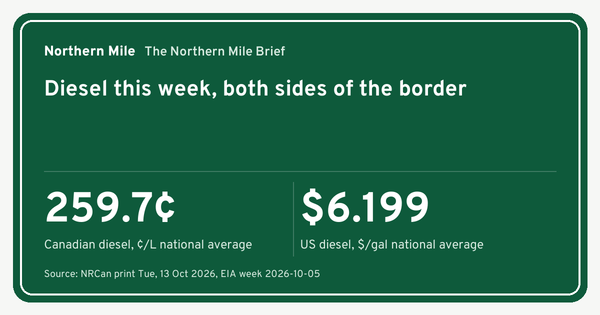
Here is the friction. Natural Resources Canada publishes Canadian pump prices in cents per litre, one national print a week. The US Energy Information Administration publishes American retail diesel in US dollars per gallon, on its own schedule. Canada measures in litres and cents. The United States measures in gallons and dollars. Neither survey hands you a shared unit, and we do not run the conversion for you.
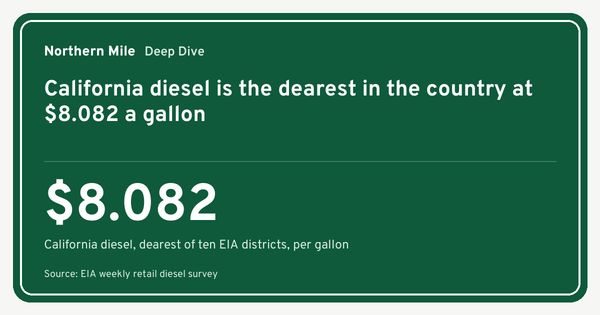
The last US reading in our feed carries no print date. I am not going to seat an undated American number next to a Canadian survey from September 29 and call the two a same-week comparison. Until the US side carries a date, it stays out.
So the comparison you can trust today sits inside Canada. Tax, freight distance and regional supply build most of the gap between 291.9 in Quebec and 223.9 in the Northwest Territories. Both countries stack federal and subnational taxes on the same barrel, and each runs its own fuel standard. An American pump price and a Canadian pump price are two totals built from different parts. A single exchange rate does not put them on one line, and that is before the litre and the gallon get involved.
The loonie at 1.4246
The Bank of Canada had CAD/USD at 1.4246 on October 2, with the loonie weakening 0.02 percent. Diesel trades in US dollars on the wholesale market and gets bought with Canadian dollars. A weaker loonie raises the Canadian cost of the same barrel on a day the barrel does not move.

The Canadian dollar against the US dollar, recent observations.
A 0.02 percent move is noise. Treat it as noise. The level is the part that compounds, and a rate near 1.42 means every US dollar purchase pulls more out of the account than it did on a stronger loonie. That is the half of a cross-border comparison the exchange rate owns outright.
It is also why a headline ratio between the two countries is worth less than it looks. Once the loonie and the gallon step are both in play, which side is cheaper depends on your conversion and your fill, not on one published figure. Put your own kilometres and consumption through the fuel cost calculator rather than trusting a number someone else converted.
Where trucks waited at the border
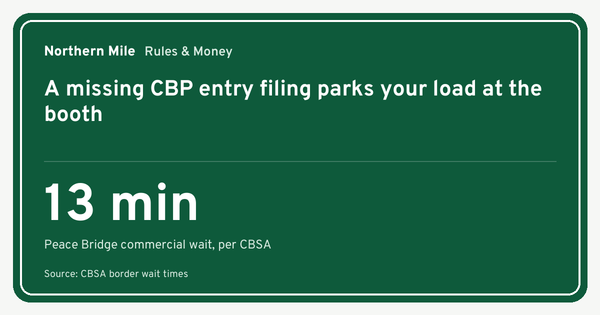
Canada Border Services Agency readings were mostly quiet. Ambassador Bridge carried the only wait in double digits, at 30 minutes, and the dashboard flags it NOTABLE. Peace Bridge ran 13. Queenston-Lewiston ran 7. Pacific Highway ran 5.
| Crossing | Commercial wait |
|---|---|
| Ambassador Bridge | 30 min |
| Peace Bridge | 13 min |
| Queenston-Lewiston Bridge | 7 min |
| Pacific Highway Crossing | 5 min |
Source: Canada Border Services Agency border wait times, current readings.

Current commercial wait times at CBSA-reported crossings.
Blue Water Bridge, Lacolle, Coutts-Sweetgrass, Emerson-Pembina and Thousand Islands all reported clear. Nine crossings are tracked on the dashboard, so most of them gave a dispatcher nothing to work around. The Ambassador Bridge board updates through the day, and the crossing index carries the rest.
What to do with this
Fuel where the spread favours you. A 68.0 cent gap between 291.9 and 223.9 is the widest lever on the board, and it is a routing question rather than a negotiation. The Quebec page breaks out the cities inside the most expensive province, and the Calgary page covers the cheap end of the map where most western freight starts.
Check the border board before a pickup time gets set, not after it moves.
Do not force the two countries onto one number. If you need the cross-border answer for your own lane, the calculator above takes your kilometres and your litres per hundred and shows what your route costs at the price you actually pay.
Where this leaves the week
Canada US diesel price comparison work is mostly an exercise in refusing to mash two systems into one. The Canadian survey is clean this week. The spread is wide, the loonie is soft and the border is quiet. That is enough to plan a fuel stop, pick a bridge and price a lane. Everything behind those numbers lives at the fuel prices hub.
Sources: Natural Resources Canada weekly diesel survey, Bank of Canada (Valet API), Canada Border Services Agency border wait times, US Energy Information Administration. Methodology and data notes are published at https://dashboard.northernmilemedia.com/methodology/nmdi/.